 |
| Dr. Charles Murray |
I have recently read a very inspiring book by Charles Murray, one of my favorite political and social scientists.
Dr. Charles Murray has a BA from Harvard in History, and A PhD from MIT in Political Science.
He has written many books, dealing with intelligence, education, class structure, education, and more. In this blog, I will deal with the subject matter in:
"Real Education: Four Simple Truths for Bringing America's Schools Back to Reality"
The book explores many of the problems with the current education system, including why students aren't getting perhaps as much as they could out of it.
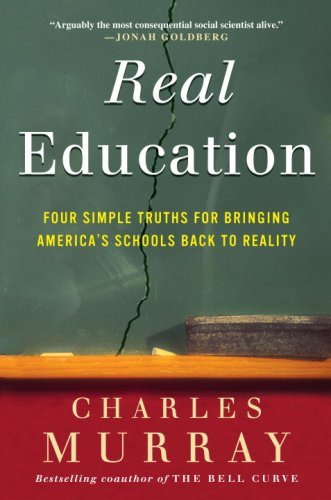
Like most books Murray has written, it spurred controversy... However, one difference with this book is that even many of his critics agreed with much of what he wrote. He said after it was released, he had never gotten so many emails starting off with: "I never thought that I would agree with you on anything, but here......"
Below I will discuss many of the themes that book shines light on, as well as my opinions on them.
"Ability varies"
This to me is so obvious, I'm not even sure why it's discussed.
To those that strive for egalitarianism (The goal of making everyone equal), this is deemed offensive.
It's interesting to me too, how new this idea really is. It was accepted for a long time, that people were just different. Some are smarter, some are better looking, some are more hard working, etc.
I find that funny in a way, because everyone knows at some level or another, that it's true. If you ask pretty much any person one on one (especially after a few drinks!), if they think everyone could have their skills in most areas brought up to the same level, they would say no.
The egalitarian mindset that has lead to people developing what Murray calls "education romanticism". To put it one way, certain idealists believe that if we spend enough on education, we could have a country full of nuclear physicists, rocket scientists, and genetic engineers.
Most people don't word it that bluntly, but that's the sort of mindset that they're operating from.
To me, that's like saying: "If we get enough of the right coaches and spend enough money on physical education, we can have a nation of professional athletes."
Now, Murray is critical of this because of variance in intelligence (I will talk more on this below). His book "The Bell Curve" discussed this in depth.
Now in my view, intelligence aside, I look at this in another light. The questions that should be asked are in my view:
"Do people, especially teenagers, really want to learn?"
" Does everyone want to learn the same things?"
"Does everyone learn well by sitting in rows and being lectured?"
" Will everyone find the same knowledge/skills valuable?"
"Can everyone learn at the same pace?"
"It it worth pushing people through classes (especially at the higher level) that they have no interest in?"
"Will what they learn in school be valuable on the job?"
I like to use this as a real world example:
My two grandfathers were in many respects, opposites. My paternal grandfather passed away shortly after I was born, so I never got to know him. Much of what I will write about him is based on what has been told to me by my grandmother and father.
My paternal grandfather had a high school diploma. His main career was working as a mechanic for the Air Force. He quit the Air Force when it started using jet engines, because he wasn't interested in learning how to work with them.
He then worked several mechanical, hands on jobs such as carpentry, and building the insides of nuclear reactors.
From what my grandmother has told me, he didn't like to read much, aside from his newspaper. (Which there's nothing wrong with, by the way.) He preferred working in his garden, building things, and working on the home.
As you can tell from reading this, he was mechanically inclined. He liked to work with his hands, and was quite good at it. An academic career wouldn't have been for him.
In fact, I know that most would even argue that being skilled at fixing up a house, gardening, and working on cars, is far more practical than the history, economics, politics, that I spend much of my time learning about.
Now, let's take my maternal grandfather. He graduated salutatorian from Gonzaga (a top prep school in Washington DC for those that don't know.) He went on to Notre Dame, graduated with Honors, and had a very successful career working his way up to the position of Northeastern Regional Manager of a major corporation (Air Products).
My maternal grandfather likes to read, and has many of my academic interests.
My point here is that if someone like my paternal grandfather had grown up in today's world, he would have been pressured into going to college ( like the majority of the population upon graduating high school), which wouldn't have been terribly beneficial for him. From what I gather, he would have been bored in classes. And had he become a mechanic anyway, he wouldn't have used much of what he had learned. Not to mention the debt he would have had to pay off, but that's another story.
I think that's one of the many flaws of the current system... This has a lot to do with the difference in types of intelligence which I will now discuss.
The types of Intelligence:
I think most people are aware on some level that there are many types of intelligence, which vary individual. A person can be strong in a few, and weak in the others.
For this subject, Dr. Murray cites the work of psychologist Dr. Howard Gardner of Harvard, and his work on multiple intelligences.
 |
| Dr. Howard Gardner |
In his book "Frames of Mind: The Theory of Multiple Intelligences", Dr. Gardner comes up with eight different forms of intelligence. He is continuing his work currently, during which he believes that he will discover more. I will discuss his original findings now:
1) Bodily- kinesthetic intelligence
This intelligence includes motor skills, hand eye coordination, and general control over ones body.
Athletes, particularly dancers and gymnasts tend to be high in this.
2) Musical intelligence
This has to do with the ability to recognize pitches, tones, and music composition.
I (and most people) might hear some music and think it sounds nice, but somebody that is more adept in this area would be able to criticize it, and figure out how it could be improved.
This ranges from someone that is completely tone deaf, to a composer such as Ludwig van Beethoven.
3) Interpersonal intelligence
This is your skill in dealing with others, and ability to detect emotions and emphasize.
Politicians and therapists tend to be high in this.
This ranges from someone that is horribly antisocial, to a charismatic politician such as Barrack Obama.
4) Intrapersonal intelligence
This is more of an understanding of oneself, and the ability to look at yourself and be critical. People that are strong in this, are good at improving themselves by identifying their strengths and weaknesses, and dealing with them.
This ranges from the unrepentant egomaniac (we all know at least one!!!) to a wise man such as Confucius or Benjamin Franklin.
5) Spatial intelligence
This is the ability to recognize, manipulate, and arrange spacial objects.
Gardner goes further in depth in his study, but this usually includes people that are both mechanically and/or artistically inclined. Those two vary slightly, but are not unrelated.
Have you ever gone to a museum and seen that person that stares at one painting for a long period of time? That person is usually stronger in this area, and will most likely pick up details that wouldn't be perceived by the average person.
A skilled navigator who could figure out where his boat is while at sea using the stars would be strong in this area as well.
This ranges from someone that gets lost in their own area, to an adventurer like Daniel Boone. (He found his way home through miles of strange woods.)
6) Linguistic intelligence
This is what it sounds like, the ability to write, speak, and interpret one's own language as well as others.
People that write professionally, and translators tend to be strong in this area.
This ranges from someone that is functionally illiterate, to a writer like Charles Dickens or Emily Dickinson
7) Logical-mathematical intelligence
This is general problem solving, and the ability to understand complex arguments, as well as understanding the cause and effect of different events.
Mathematicians and physicists are very high in this.
This ranges from somebody who can't grasp obvious cause and effect, to a great thinker like Aristotle or Plato.
8) Naturalistic intelligence
This has to do with ones understanding of nature, how the ecosystem works, knowledge of plant and animal life, etc.
Biologists and botanists are strong in this area.
This ranges from someone that is entirely ignorant about nature, to somebody like Jacques Cousteau.
What does this all tell us?
I think most people can read this, and realize that they are strong in certain areas, and weaker in others.
I was never terribly athletic, and I'm fine with that. I have never aspired to becoming a professional athlete, and it's obvious that the vast majority of the population can never reach that level.
I don't have a great ear for music, but again, I'm okay with that. Never wanted to be a professional musician. I do appreciate a variety of music though.
I do seem to have a good knack for languages. I'm not fluent, but I have easily picked up the French, German, and Spanish that I have been exposed to. I also seem to have pretty good reading comprehension skills, and try to speak using proper grammar.
Again, this is just me.. anyone reading this will vary in their one way.
I think that much of the problem with the current education system is that it just sort of dumps everyone into this "one size fits all" curriculum which only benefits certain people. Some people identify their strengths and weaknesses, but many get lost in the shuffle. (Myself included.)
The problem is that when academia is brought into this, telling a child that they shouldn't take a class is akin to calling that child stupid.
For the purpose of this blog, unlike Murray in my assessment of all of this, I'm not focusing so much on raw standardized test and IQ scores. It's more willingness to learn, and capability of learning it. Some people struggle in certain areas, and that's okay.
At the root of all this, one of the biggest problems is the whole "everybody gets a trophy, because everyone's a winner" and "you can be whatever you want if you just believe in yourself" mentality.
Those lines are pure propaganda. Anyone who lived in the real world knows this for a fact.
This does nothing in my view, but generate false faith in a child, and direct them into things that they aren't suited for.
Cooking wasn't the right career for me (You can read my other blog on career changing if you want to hear more about my thoughts on this) and I'm fine with that. I'm wiser, more confident with myself, and disciplined than I was a few years ago, from when I began that career experience. And I did learn more about myself and the real world, so it wasn't a complete loss.
"Half of the children are below average":
Now here's why the controversy really begins. Although this sounds harsh at first, like the above point we know that it's true to some degree.
Below average doesn't mean, below average in all respects.
It means below average in usually a few of the categories mentioned above.
Some facts here:
About 1 out of 4,600 workers makes their career in an athletic related field..
About 1 out of 2,200 workers earns their living involving music.
Murray, (as well as others) have gotten in trouble for emphasizing IQ and what it can mean for a child's future.
However, he also says (what he says in reality, as opposed to snippets of him taken out of context.) that IQ shouldn't be seen as an "end all" data point.
If you want to take the extreme example, Muhammad Ali's IQ was 78 according to his Armed Forces IQ exam. He obviously lived a very successful life.
Murray himself has even stated that although is IQ is above average, it is not exceptional. He believes that he could never be an astrophysicist, for example.
Interpersonal and intrapersonal intelligence aren't even factored into most IQ tests. IQ tests generally deal with logical-mathematical, spatial, and linguistic intelligences. And even that is kind of vague, because one can be strong in one of those, and weak in the others.
IQ tests also don't factor in motivation, work ethic, self discipline, curiosity, attitude, etc.
My understanding is that a person with a higher IQ has a better shot at more intensive academic career, usually involving higher math skills.
For example, a person with an IQ of 120 (which is 20 points above average) could become a physicist, but they would be on the lower end of the IQ spectrum of that profession. That person would have to study harder in order to grasp the math, but could do it with enough hard work. Rocket scientists typically start at a minimum of 130.
"Too many people are going to college."
I read this section, and it reminded me of what I wrote in my other blog about the current education system, although with several new additions.
Only about 20% of college applicants can handle traditional college level work.
This actually isn't surprising in my view. Consider what the average person reads (if they read at all.) Also think for a minute about what most of these applicants want to read.
Now lets examine a piece of classical literature:
"The Protestant Reformation could not have occurred without the monumental crises of the medieval church during the "exile" in Avignon, the Great Schism, the conciliar period, and the Renaissance papacy. For increasing numbers of people, the medieval church had ceased to provide a viable religious piety. There was crisis in traditional teaching and spiritual practice of the church among its intellectuals and laity. Between the secular pretensions of the papacy and the dry teachings of Scholastic theologians, laity, and clerics alike began to seek a more heartfelt, idealistic, and-often in the eyes of pope-increasingly heretical religious piety." (The Western Heritage, by D. Kagan, S. Ozment, and F.M. Turner.)
I can grasp most of this fine, because I read lots of history regularly. However, I think I can safely say the majority of people don't, and would struggle a bit with this passage. And if they can't understand it fully, they don't gain perhaps as much as they could from it.
This is just a literary example. Math is even worse. I know people that need a calculator to figure out problems as simple as 170 x 2, 113+7, 120/3, etc.
I, as an American find it embarrassing that children in other countries can do far more complex math without calculators, despite spending far less money on schooling.
The four year brick and mortar school is obsolete.
This was perhaps one of my favorite parts of the book, because I felt that it really was outside the box. Yet, it made a lot of sense once broken down.
It begins by asking a very simple question with a direct answer:
"Are four years of formal schooling necessary to make a living?"
"In a sensible world, hardly ever."
Now, I think that this depends on the profession. Obviously, I wouldn't want to be operated on by a doctor who got an online degree. That sort of profession requires direct, hands on, teaching.
A PhD doesn't require four years of work, and that signifies expertise in a given field. Not the amount of time spent in a classroom.
What about restaurant managers, software entrepreneurs, social workers, journalists, accountants, etc?
Remember, that I'm not talking about learning how to get better at the job, and work your way up. That takes years. I'm simply referring to the necessary training to get started in that direction.
A four year live in college used to make sense for three main reasons.
1) A good library was important for accessing information. Before the internet, it was harder to have access to such a wide array of material.
2) Colleagueship. Having experts who could regularly confer with each other made education far more effective.
3) Direct interaction between teachers and students.
Now, these reasons are fast becoming obsolete.
1) We live in an era where information is more accessible then ever. A friend recently made the comment to me: "Anyone graduating from college after the mid 90's can learn just about anything that they would have been taught in class via Google." I think that is true of most professions. Again, not something like medicine where more direct training is a necessity, but most things. I hold in my possession a couple hundred of E books, many of which I downloaded for free. Just because you want to learn about a subject, doesn't mean that you have to pay a couple hundred grand to learn it.
2) This has been solved to some degree due to the internet as well. The flow of information allows experts to both communicate and challenge each other, and this information is readily accessible for most people. You don't have to travel to expose yourself to the minds of multiple experts.
3) Again, depending on the career, this isn't a necessity. Distance learning has become more and more common, which makes this less important too.
"The BA is the work of the devil"
This is perhaps one of the statements Murray is best known for.
Here's what he mean by this:
A BA (Bachelor of Arts. A Bachelor of Science would be included here as well. He just says BA to simplify the statement.) doesn't say a whole lot about the person, unless it's for a very specific skill tailored to the job. (Such as engineering.)
The only way this makes the person stand out further, is if they have a degree from a better known school. For example, a graduate from Harvard will stand out more than a student from Marist.
Yet, this doesn't really say anything about the people as individuals, and what they bring to the table.
And if the BA becomes the new high school diploma, it will be virtually meaningless, and everyone will need at least a Masters to do anything.
What is a better alternative?
I (and Murray) really like the idea of going to a series of tests and certifications that would be better suited for the job.
An example:
Three people graduate with BA's in restaurant management.
One has a degree from Harvard, one has a degree from a lesser known school, and the other completed their work online.
What does this say about the employees as individuals? Not much of anything. The person who went to Harvard might be smarter, or they might simply come from a wealthy family that got them in.
A company, such as Ritz Carlton could administer a test, which could assess the person's skill level. The test would be relevant to the job. In the case of restaurant management, the test criteria would be steps of service, food and wine knowledge, organization, etc. All of this would be decided by the people administering the test.
There could also be varying levels of certification, such as there are "Advanced" versus "Master" sommeliers, and "Certified Executive" versus "Certified Master" chefs.
Now, if the person who did their work online got the highest score out of the three, this would level the playing field considerably. The person proved that they were the most competent with the material. It didn't matter how they acquired it.
I think this would make things more fair, and also yield better results. A company like Ritz Carlton would only issue certifications to people that they knew were qualified, because they wouldn't want to hurt their own reputation. And they could charge a fee for the trouble, which would make them more money.
So what can be done?
I believe that there are a number of solutions here, some of which I talked about in my blog about education.
1) I love the idea of a voucher system.
For those that don't know, Here's how it works:
Parents are given a voucher, which gives them a choice where to send their children to school. This is supposed to level the playing field. For example, a child that is from the ghetto can now attend a school in a nicer area. This gives them a shot at getting a better education, which will ultimately help them get out of their environment.
2) The certification process as desribed above. I feel that the core solution is to introduce a system which gives people a chance to prove what they learned, but without costing them an arm and a leg.
Employers need to be able to view people as individuals, and know exactly what that person can bring to the table. What they know, how competent they are, and what sort of specialized skills that they could develop.
And again, with information as accessible as it is, you don't have to spend a fortune to learn about something.
3) Get rid of No Child Left Behind. Leave the standards to be decided by teachers locally, not by legislators far away in Washington.
4) Tailor education more to the individual. If a child struggles in algebra, they shouldn't have to take it any more. However, the child's other strengths should be identified, and the child pushed more in that direction. For example, a child that struggles with math, but excels with reading and writing would be required to take an advanced literature course instead. Perhaps children that are more athletic could be pushed into a more advanced physical education course, where they are pushed to their limits. I realize that we have remedial and honors courses now, but I feel that those principles need to be pushed more to the extreme.
5) Studies have indicated that one of the biggest determining factors in a child's education, is the amount of parental involvement. In fact, one of the prominent reports (The "Coleman Report") says that this is more important than the quality of the school itself. I'm not sure how to bring this about. I think that there just has to be a cultural shift, brought about by conversations that will be brought about by works such as this blog, and the book it was based on. Similar to how after enough people said that the Earth revolves around the Sun, it became common knowledge.
6) There need to be harsher punishments for children acting up in class, especially poor areas. I had a friend who grew up in a poor area, get beaten up for doing well ("acting white"). This isn't uniquely American either... it happens in poor, white, working class areas in Great Britain as well. Perhaps there needs to be junior juvenile centers for children such as this? I'm not sure. And some kids are just beyond help. People say that they "won't learn anything" if they are kicked out of school. I would ask: "Will they actually learn anything if they stay?" and "Is it right to punish the kids that do want to learn?"
7) Let students work at their own pace. This may sound radical, but I wonder if the whole system of grades needs to be changed. Does it make sense for someone who breezes through math, to be in a class with someone like me who struggled in it? Does it make sense for someone like me who reads history for fun (as funny as that sounds to most people) to be in the same class as someone who has no interest in it whatsoever?
8) Glorify the trades, and other blue collar work. Many look down on this as "what stupid people do" and I think that's both insulting, and untrue. Although I don't cook anymore, I'm glad in many respects that I did it. It instilled in me, a sense of discipline, and the ability to think on the fly. There's nothing wrong with earning a living using your hands. And many of these jobs pay very well. Dr. Murray talked about a young man in his early 20's who does marble work. He creates beautiful sculptures, tile work, and pillars on houses for wealthy clients. He started off at $30 an hour, which is more than three times what cooks start off at. And he's happy, and takes lots of pride in his work. Anyone who watches "Dirty Jobs" with Mike Rowe, sees lots of these sorts of jobs advertised.
9) Encourage children to work earlier. This may sound radical to some, but I think the child labor laws should be abolished, and the working age lowered. Here's why:
You have to consider the types of work that children were doing when these laws were put into place. Nobody wants to go back to little boys sweeping chimneys or working in coal mines, and getting black lung disease.
Would it be wrong though, for teenagers to work in air conditioned offices, carrying out menial tasks such as cleaning, and sorting papers?
Having a job teaches you to deal with authority, show up on time, work with people that you don't get along with, etc. I think it's important that this gets instilled at a young age. A person could end high school having had a few jobs, and real world experience already. This would be better than today's world, where many graduate high school with only unpaid internships as experience.
I think that this would lead to better performance in school as well.
I'm not an educator, and I'm speaking strictly as a layperson. However, I really care about the future of our society, and I think that these are conversations that need to be discussed. If anyone reading this has a background in education, feel free to say whatever you would like. I would really like the feedback.
Thank you all for reading! Hope that you enjoyed it!
-STK
